
RetraceKit vs Bugsnag: best Bugsnag alternative for indie hackers
RetraceKit is the Bugsnag alternative built for indie hackers and small teams: 100k free stored events, incidents, AI summaries, and plans under $15/mo. Pricing, fit, and FAQ.
Ildar Timerbaev
RetraceKit is the Bugsnag alternative for indie hackers and small teams who want production crash triage without buying an error-plus-performance platform. If your job this quarter is “what broke, and how do I fix this outage once?”, RetraceKit usually wins on free capacity, bill shape, and incident-shaped workflow. Bugsnag (SmartBear) remains the stronger pick when you need multi-platform SDKs, performance spans, and release stability in one product.
Need a 30-second pick? Use the RetraceKit vs Bugsnag decision page. This post is the longer pricing and fit write-up. Related: RetraceKit vs Sentry.
How does RetraceKit pricing compare to Bugsnag?
Indie and small-team budgets fail when you compare list prices without comparing units. Bugsnag meters error events and performance spans you send each month. RetraceKit caps concurrent stored events per project and drops the oldest rows when the cap fills (FIFO), while the SDK keeps sending.
Bugsnag Free includes 7,500 events and 1 million spans per month for one user, with 7-day retention, 50+ platforms, and 30+ third-party integrations. Paid Select and Preferred tiers scale by chosen event and span bands, with 60-day retention. Public list pricing puts Select around $20/month and Preferred around $33/month; Preferred adds prioritization, stability benchmarks, and SSO. Figures from Bugsnag’s pricing page.
RetraceKit Free keeps 100,000 stored events with 7-day retention and no card. Plus is $5.99/month for 200,000 events and 14 days. Pro is $14.99/month for 500,000 events and 30 days. Incidents and AI summaries ship on every plan. Figures from RetraceKit plans.
Price figures below are public list prices as of August 2026. They do not include promotions, trials, partner discounts, or negotiated enterprise quotes — verify on each vendor’s pricing page before you buy.
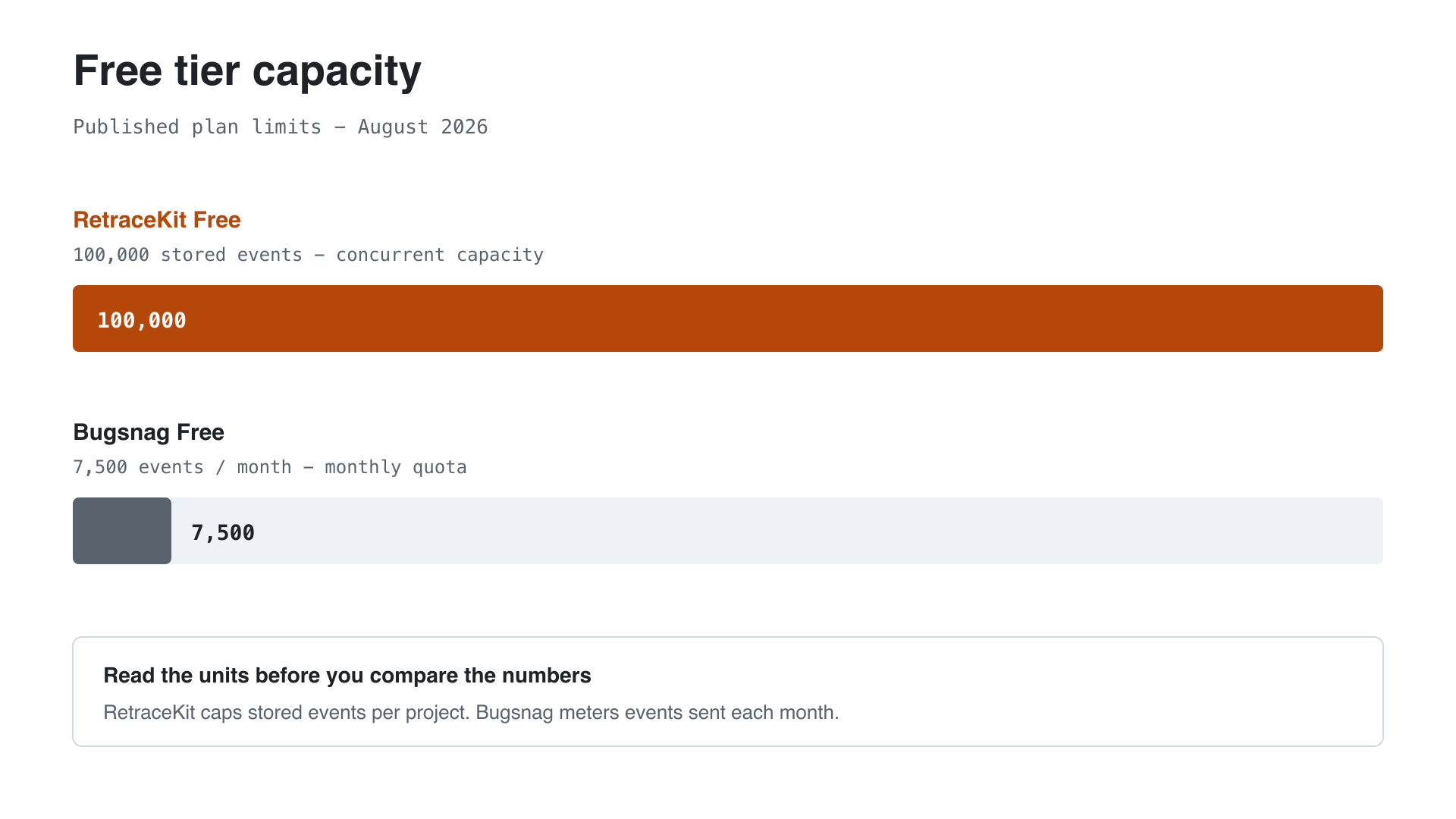
That unit difference matters for indie hackers. A noisy deploy that sends a few thousand errors can exhaust Bugsnag’s 7,500/month free quota in a day and leave you waiting for the next cycle or an upgrade. On RetraceKit Free the same spike fills storage, then oldest events fall off while new crashes keep landing. You lose history at the tail. You do not lose ingest for the rest of the month. For a solo founder or a two-person team shipping a JS/TS app, that storage model matches how side projects actually break.
Which paid plan fits indie hackers and small teams?
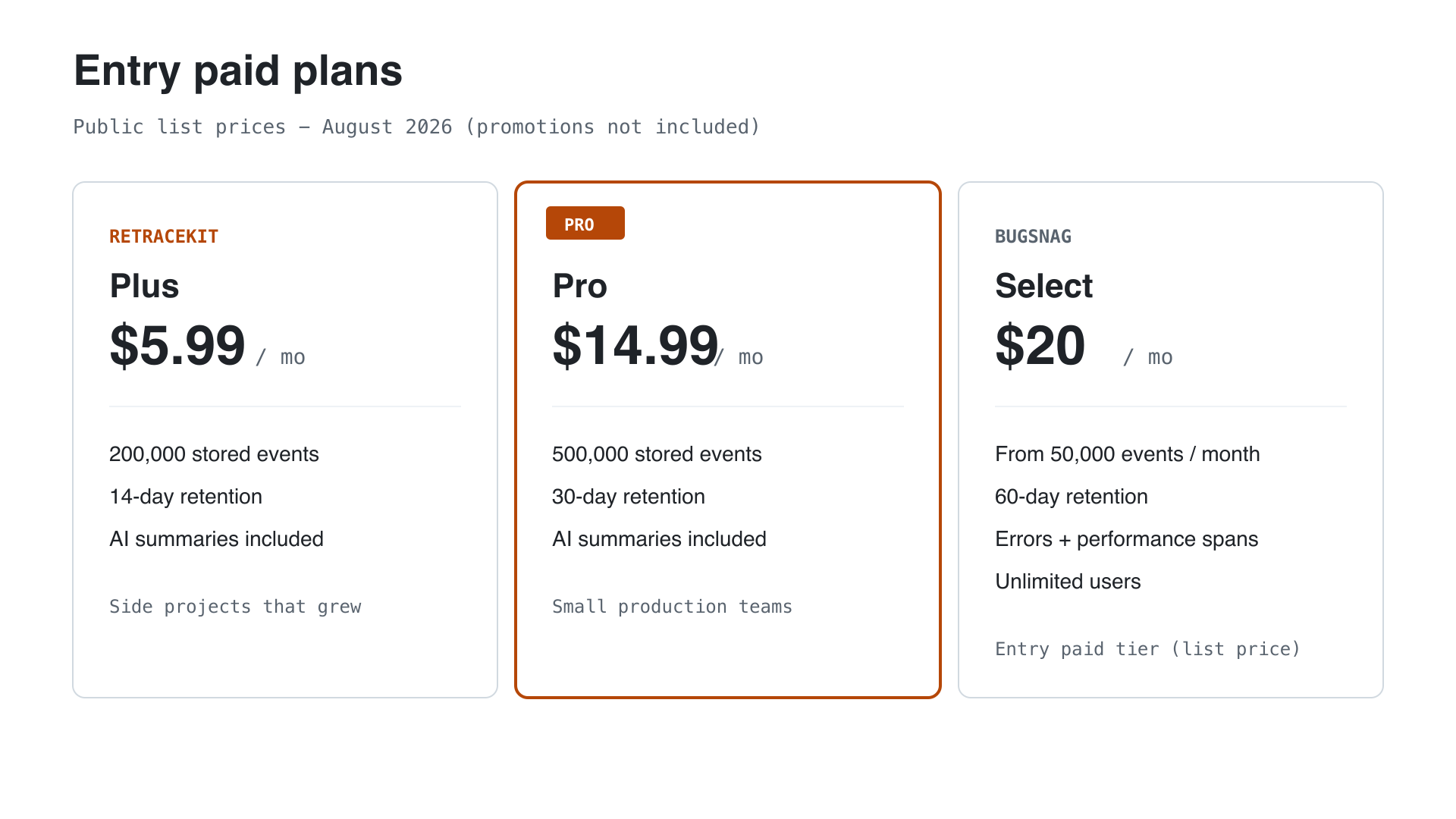
For a budget under $15/month, RetraceKit Plus or Pro covers error tracking, automatic incidents, AI summaries, and 3rd-party integrations. That band is the intentional home for indie hackers and small product teams. Bugsnag Select from about $20/month buys unlimited seats, longer retention, and error-plus-performance monitoring with chosen event and span bands. Preferred from about $33/month adds the stability and prioritization workflow many larger product orgs expect.
Pay for Bugsnag’s paid bands when your team will open span dashboards and stability scores every week. A weekend SaaS or early startup that needs stack traces, one incident inbox, and an alert ping can ship on RetraceKit without those line items. Full numbers: RetraceKit pricing.
What does each product cover?
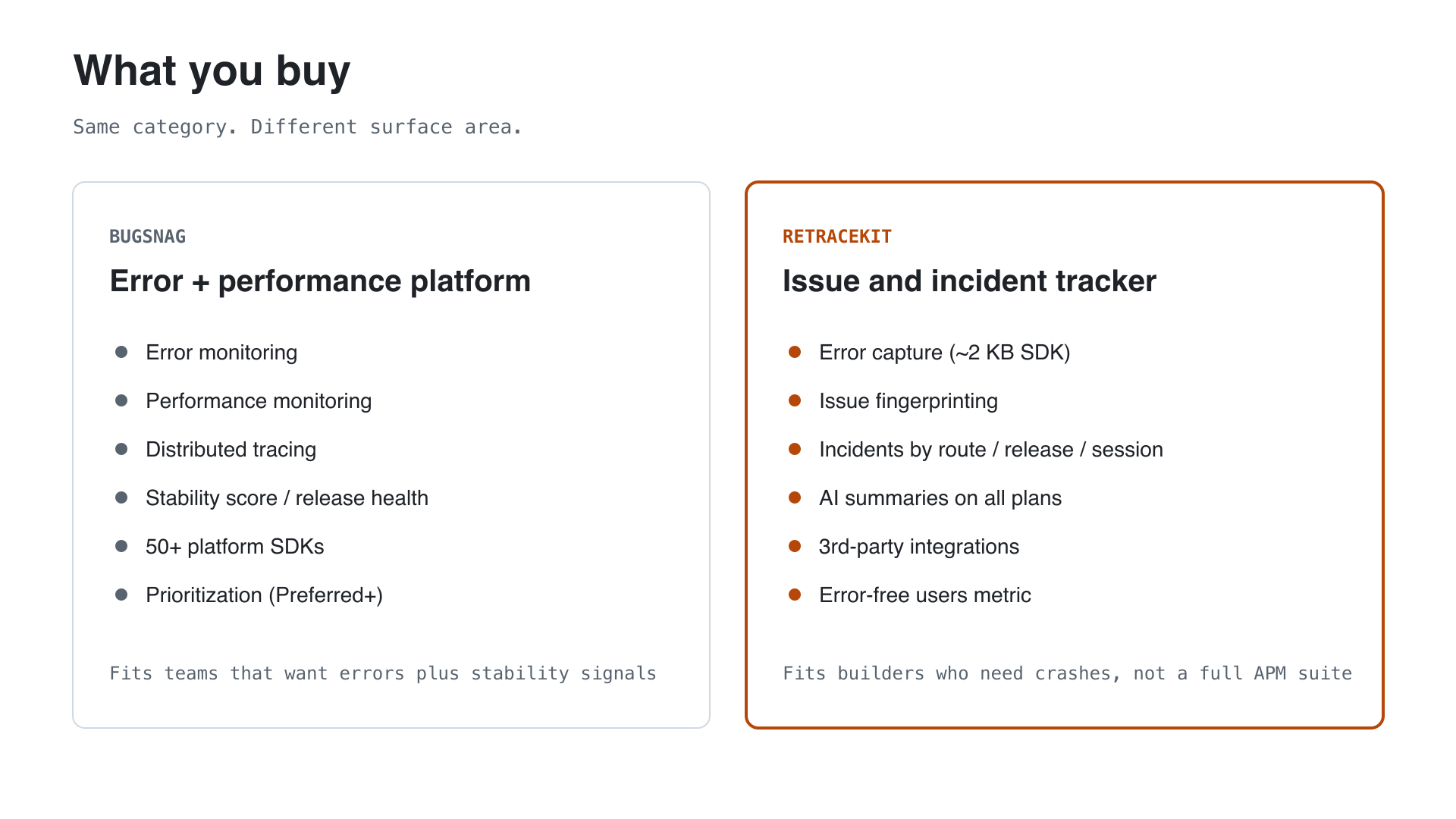
Bugsnag pairs error monitoring with performance monitoring and distributed tracing, with a long mobile and multi-platform SDK catalog. Higher tiers add release stability signals, automatic prioritization, segmentation, and SSO. Teams that want one vendor for crashes and stability get that breadth in one place.
RetraceKit ships a thinner stack aimed at indie hackers and small teams:
- ~2 KB gzipped TypeScript SDK with automatic uncaught-error capture
- Issue fingerprinting so identical crashes share one ticket
- Automatic incidents that cluster related issues by route, release, or session
- AI summaries on Free, Plus, and Pro for issues and incidents
- 3rd-party integrations for alerts
- An error-free users metric for a quick health read
When three fingerprints light up the same route after a release, you triage one incident and read the AI brief before cloning the repo. That is the unit of work a solo developer or a five-person team can finish before lunch. Details: how incidents work.
Who should pick RetraceKit or Bugsnag?
Indie hackers and solopreneurs. RetraceKit is the default. You want free capacity that survives a noisy week, a small SDK, AI briefs without a paid add-on, and alerts through 3rd-party integrations. Free stores 100,000 events. Bugsnag Free fits if you stay under 7,500 events/month and already want performance spans and a wide platform SDK catalog on day one.
Small teams (about 2–5 people). RetraceKit Pro at $14.99/month keeps a shared incident inbox, 500,000 stored events, 30-day retention, and AI under fifteen dollars. Bugsnag Select from about $20/month fits when unlimited seats and the error-plus-performance stack are already how the team works every week.
Pet projects. Prefer a tool you can ignore until production breaks. Storage plus FIFO keeps RetraceKit ingest open after spikes. Bugsnag Free protects the plan by capping monthly sends until the next cycle or an upgrade.
Best for (quick extract)
| Who | Job this quarter | Better fit |
|---|---|---|
| Indie hacker / solo | Crash triage under $15/mo | RetraceKit |
| Small JS/TS team (2–5) | Shared incident inbox, quiet bill | RetraceKit |
| Multi-platform / mobile-heavy team | Errors + performance + stability | Bugsnag |
| Org standardizing on SmartBear tooling | One vendor for crashes and spans | Bugsnag |
Quick reference
| RetraceKit | Bugsnag | |
|---|---|---|
| Best for | Indie hackers and small teams | Teams needing errors + performance |
| Free capacity | 100,000 stored events | 7,500 events / month (+ 1M spans) |
| Free seats | Project-based access | 1 user |
| Entry paid | Plus $5.99 / Pro $14.99 | Select from ~$20/mo |
| Billing unit | Concurrent stored events | Monthly events (+ spans) |
| Browser SDK | ~2 KB gzipped | Full multi-platform SDKs |
| Grouping | Issues + incidents | Error grouping (+ stability / prioritization on paid) |
| AI | Summaries on all plans | Workflow tooling on higher tiers |
| Alerts | 3rd-party integrations | Integrations on Free; richer notifications on paid |
| Scope | Error + incident tracking | Error + performance monitoring |
Sources: retracekit.cloud/docs/plans, retracekit.cloud/pricing, bugsnag.com/pricing. List prices as of August 2026; promotions and custom quotes not included.
Bottom line
RetraceKit is the Bugsnag alternative for indie hackers and small teams: issue-centric tracking, automatic incidents, AI summaries on every plan, and a bill that stays under fifteen dollars for a small production app. Choose Bugsnag when you want errors, performance, and release stability across many platforms in one product.
Start free at app.retracekit.cloud. Setup: retracekit.cloud/docs/setup. Decision page: RetraceKit vs Bugsnag.
FAQ
Is RetraceKit a good Bugsnag alternative for indie hackers?
Yes. RetraceKit is built for indie hackers and small teams who need production crash triage without Bugsnag’s performance and stability platform. Free includes 100,000 stored events and AI summaries with no card. Plus is $5.99/mo and Pro is $14.99/mo. Pick Bugsnag when you need multi-platform SDKs plus performance spans and release stability in one vendor.
Which is cheaper for a solo or small-team app, RetraceKit or Bugsnag?
RetraceKit is cheaper for most indie budgets on published list prices as of August 2026 (promotions and custom quotes not included). Free stores 100,000 events with FIFO retention. Paid plans stay under $15/mo. Bugsnag Free caps at 7,500 events per month for one user. Bugsnag Select starts around $20/mo and Preferred around $33/mo. Compare units: RetraceKit meters concurrent storage; Bugsnag meters monthly send volume.
When should a small team still choose Bugsnag?
Choose Bugsnag when the team will use error monitoring together with performance monitoring, distributed tracing, and release stability scores across many platforms. Unlimited seats on Select and the wider SmartBear tooling matter more than a thin incident inbox. If your weekly workflow is crash triage and messenger alerts under $15/mo, RetraceKit fits better.
How does RetraceKit grouping differ from Bugsnag?
Both group identical crashes into issues. RetraceKit also opens an automatic incident when different fingerprints share a route, release, or session, so a solo developer or small team triages one outage. Bugsnag emphasizes error grouping plus stability and prioritization workflows on paid tiers. RetraceKit includes AI summaries of issues and incidents on Free, Plus, and Pro.